

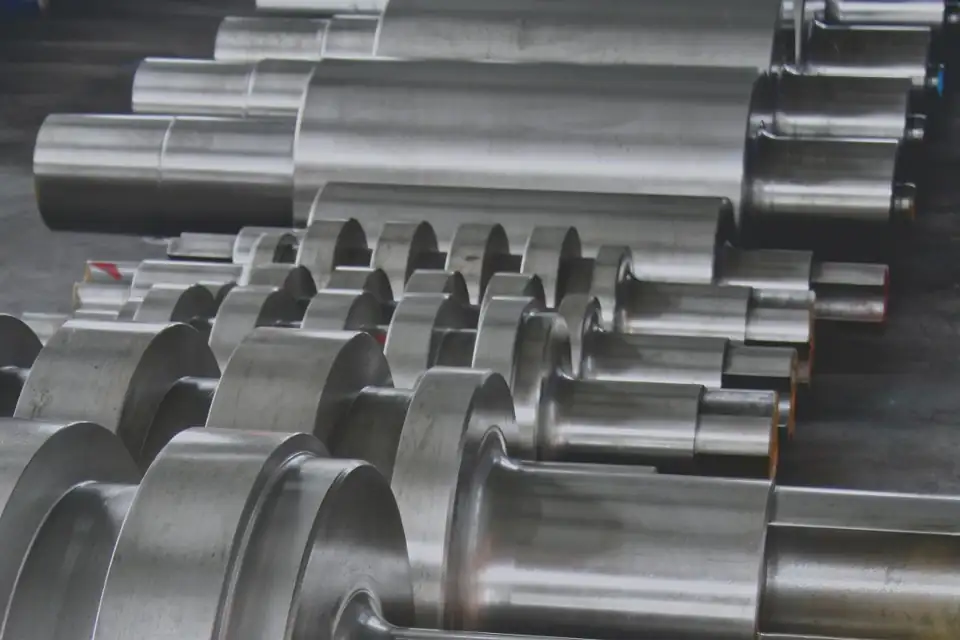
Box, oval and plain barrel rolls for the first stands of the mill.
In the first stands of the mill the stock is hot and the bar speed is low, so contact time and contact angle are high. Wear here is mainly thermal: fire cracks and a poor roll surface.
Breakage and impact damage are also most common from roughing to intermediate, because the reductions are heavy. These stands need a roll material with good bending strength and fracture toughness. Depending on mill conditions, conventional grades give improved wear resistance in these early stands.
- Box and oval passes in roughing and intermediate stands
- Plain barrel rolls for billet and bloom reduction
- Bar, rod and light section mills
- Grooved rolls made to your pass design
Available grades
Material grades
SG Pearlitic
SG Pearlitic iron has nodular (spheroidal) graphite and carbides in a pearlitic matrix. Its properties are close to Alloy Indefinite Chill, but the graphite is in spheroidal form instead of flakes, so SG Pearlitic rolls have higher strength.
It is suitable for both roughing and finishing stands and covers a wide range of applications.
Variants: SGP alloyed with chromium gives deep carbide penetration, a lower hardness drop and good wear resistance — recommended for rolls with deep grooves. SGP alloyed with molybdenum and nickel, with high-temperature heat treatment, gives excellent resistance to fire cracks, high strength and better impact resistance than flake graphite iron.
Production type
Chemical composition (%)
| C | Si | Mn | Ni | Cr | Mo |
|---|---|---|---|---|---|
| 3.00–3.40 | 1.00–2.00 | 0.30–0.80 | 1.00–2.60 | 0.10–0.90 | 0.30–0.80 |
Properties
SG Acicular
SG Acicular is alloyed with nickel, manganese and chromium and has a bainitic–acicular–martensitic matrix. It has higher tensile strength, higher hardness and better wear resistance than SG Pearlitic.
Semi-continuous carbides keep the wear resistance, while the grade keeps high strength and good resistance to fire cracks. A full heat treatment cycle makes sure the matrix is acicular.
Chromium-alloyed SG Acicular grades give deep carbide penetration, a lower hardness drop and better wear resistance — recommended for rolls with deep grooves.
Production type
Chemical composition (%)
| C | Si | Mn | Ni | Cr | Mo |
|---|---|---|---|---|---|
| 3.00–3.50 | 1.00–2.20 | 0.30–1.00 | 2.50–5.00 | 0.30–1.50 | 0.30–1.00 |
Properties
Alloy Indefinite Chill
Alloy Indefinite Chill (AIC) rolls are cast iron with fine interdendritic graphite spread evenly through the barrel. The size, shape and distribution of the graphite, and the carbide content, are controlled by the chilling effect and the alloy content.
Alloys such as manganese, nickel, chromium and molybdenum change the matrix from pearlitic, through bainitic, to martensitic. This improves strength, hardness in depth and wear resistance. The fine graphite improves thermal conductivity, which reduces fire cracks, and its damping capacity helps to reduce spalling when large reductions are needed.
The gradual change of hardness makes AIC ideal for deep grooves. It is used in roughing and finishing stands for bars and sections, and in roughing and intermediate stands of wire rod mills. Martensitic AIC with high hardness is suitable for finishing stands of wire rod mills.
Production type
Chemical composition (%)
| C | Si | Mn | Ni | Cr | Mo |
|---|---|---|---|---|---|
| 3.00–3.50 | 0.60–1.20 | 0.50–1.20 | 1.00–5.00 | 0.70–2.00 | 0.10–0.50 |
Properties
Need roughing & Intermediate Rolls?
Send your drawing and stand details — we reply with a grade proposal and offer.